

Pinterest Marketing for Shopify: What Actually Drives Sales (and What Doesn’t)
If you’re running a Shopify store and considering Pinterest as a sales channel, the short answer is: it works, but only when it’s done properly.
Pinterest marketing for Shopify drives sales for brands with visually compelling products and customers who plan before they buy. It puts you in front of high-intent buyers while they’re still deciding who to buy from, and the traffic it delivers converts well. But it only works when it’s treated as a proper channel with the right strategy behind it.
This article is for CMOs and e-commerce managers at brands that are already on Pinterest and not seeing the results they expected, or brands that are spending real budget on Pinterest ads and questioning whether the strategy is right. I’ll give you a clear picture of what works, what doesn’t, and what it actually takes to drive Pinterest e-commerce sales from your Shopify store.
Why Pinterest behaves differently to every other channel
Pinterest is not social media. It’s a visual search engine, and that distinction matters more than most brands realise.
On Instagram or TikTok, people are served content based on what the algorithm thinks they’ll enjoy. They’re in entertainment mode. On Pinterest, people are actively searching. They have a room to decorate, a wardrobe to build, a holiday to plan. They’re in planning mode, which means they’re considerably closer to spending money.
Around 97% of searches on Pinterest are unbranded. People search for “minimalist living room ideas” not “IKEA furniture.” For brands that aren’t yet household names, that’s a significant advantage, because it means you can get in front of genuinely interested buyers before they’ve decided who to buy from. You’re not fighting for share of voice against established brand names. You’re competing on relevance and visual appeal.
The other thing that makes Pinterest different is content longevity. A pin can drive traffic and sales for months after it’s published. That’s fundamentally unlike every other paid or organic channel, where content has a lifespan measured in hours or days. A consistent Pinterest presence compounds over time, but it takes time to build.
Pinterest vs Meta for Shopify brands: different roles, not competitors
Meta is interruption-based. Pinterest is intent-led. On Meta, you create demand by placing your product in front of someone and hoping it resonates. On Pinterest, demand already exists. Someone types “neutral bedroom ideas” or “winter capsule wardrobe.” They’re not looking for your brand specifically. They’re exploring options.
That difference creates three structural contrasts worth understanding.
Demand shaping versus demand capture. Meta excels at shaping desire quickly. Pinterest captures and influences it earlier in the planning process, weeks or months before a purchase.
Speed of feedback. Meta delivers fast conversion signals. Pinterest shows a longer lag between first touch and purchase. That doesn’t mean it’s less effective. It means you’re measuring different things.
ROAS expectations. Meta campaigns are judged on short attribution windows. Pinterest marketing for Shopify requires a broader view of assisted conversions and time-lag behaviour.
This does not mean Pinterest replaces Meta. In a balanced acquisition mix, Meta drives immediate scale. Pinterest marketing for your Shopify brand builds discovery layers that keep feeding new, high-intent traffic into the funnel. The brands that treat Pinterest as “Meta but slower” misjudge it. The brands that treat it as a search-driven discovery engine extract far more value.
Is your Shopify store actually a good fit for Pinterest?
Pinterest works well for some Shopify brands and falls flat for others. It’s worth being honest about where you sit before committing significant time or budget.
Pinterest performs consistently well for home decor, interior design, fashion, beauty, food, travel, wedding, and lifestyle brands. More broadly, it works for any product that benefits from being seen in context: shown in a room, worn by a person, used in a recipe, or placed in an aspirational setting. If your products are visually compelling and your customer is making a considered purchase, Pinterest is likely a strong fit.
It underperforms for commodity products, B2B (with some exceptions in design-led sectors), highly technical items, or brands where the purchase decision is driven by spec rather than inspiration. If your customer’s buying journey starts with a Google search for a specific product name or model number, Pinterest probably isn’t your best acquisition channel.
Average order value matters too. Pinterest users are planners with purchase intent, and they skew towards higher-value purchases. Brands with an AOV above £50–£80 see better returns than those selling low-cost impulse items.
Pinterest works when a few conditions line up:
- Visual products that benefit from being seen in context
- A product catalogue large enough to give Pinterest’s algorithm data to work with
- A website that already converts
- A backend that connects to shopping feeds, or a strategy that works without one
When those are in place, the channel compounds. Pin saves build intent. Return visits become purchases. Paid campaigns sharpen over time.

How do you stack up for Pinterest?
Take this free, 2-minute assessment to evaluate your brand’s Pinterest potential. You’ll receive a personalised score and proven tactics I use to help my premium clients grow website traffic and sales with Pinterest.
The Pinterest-Shopify setup most brands get wrong
Before strategy, you need the foundations in place. Most brands with a Shopify online store have the Pinterest app installed, but that’s not the same as having a properly configured setup.
Your website needs to convert before Pinterest can help
A home decor brand came to me recently wanting to run Pinterest ads. Strong product range, beautiful imagery, exactly the kind of brand Pinterest rewards. But something about the website felt off. They shared that their conversion rate was well below 1%. They figured Pinterest could help improve this.
Pinterest would have sent the right people. But the site wasn’t ready for them.
This is more common than you’d think. The data is patchy, or split across tools that don’t agree, or nobody has looked recently. So the assumption becomes “we need more traffic” when the real question is “what’s happening with the traffic we already have?” Adding a new channel doesn’t fix a conversion problem. It’s an accelerant, and accelerants only work when there’s something to accelerate.
Catalogue connection: important, but not always straightforward
The Pinterest tag is the equivalent of the Meta pixel. Without it installed correctly on your Shopify store, you have no conversion data, no ability to build retargeting audiences, and no insight into which pins are actually driving purchases. Pinterest’s app installs it automatically when you connect your catalogue, but it’s worth verifying it’s firing on all the right events, particularly Add to Cart, Checkout initiation, and Purchase completion.
But not every Shopify store has a clean add-to-cart setup. A paint brand I worked with had a guided journey that helped customers find the right product. High conversion rate. Well designed. But because of how their Shopify backend was structured, connecting the product catalogue to Pinterest required substantial dev investment.
Does that mean Pinterest wasn’t right for them? No. Their product category and imagery were a strong fit. Organic performance was good. Paid campaigns could still run, just not catalogue-based ones. Even without a catalogue connection, Pinterest can still convert. Some of the brands I work with don’t sell online directly. B2B home decor brands using Pinterest to get in front of architects and interior designers, for example. No shop. Just visibility, intent, and inbound enquiries.

Verified Merchant status and catalogue setup
Verified Merchant status is a no-brainer. It’s easy to apply and comes with several free benefits: a trust signal on your profile, a direct call-to-action button on your product pins, and eligibility for inclusion in related product listings. If you’re not verified, you’re simply leaving free distribution on the table.
To get there, your Shopify store needs a few things in place:
- A Pinterest business account with your website claimed
- The Pinterest app installed from the Shopify App Store and added as a sales channel
- Your product catalogue connected to Pinterest (the app handles this automatically and keeps prices and availability current)
- The Pinterest tag installed and verified, firing on Add to Cart, Checkout initiation, and Purchase completion
Once connected, you’ll also have access to Pinterest analytics, which gives you visibility into which pins drive the most saves, clicks, and outbound traffic. Next, apply for Verified Merchant status through the Business hub in your Pinterest account or check out the setup guide here.
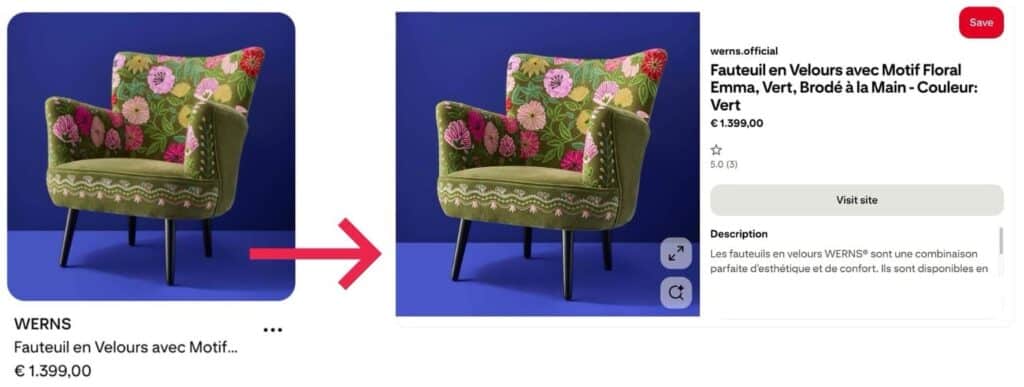
Your catalogue connection pulls live product data into Pinterest, so prices and availability stay current. These rich pins display real-time product information directly in the feed, which is valuable, but many brands treat catalogue pins as their entire Pinterest strategy. They’re not. That’s such a missed opportunity. Catalogue pins are infrastructure. Strategy is what goes on top.
How to build a Pinterest shopping strategy that actually converts
A Pinterest strategy that drives Shopify sales has three components: the right content, consistent distribution, and keyword alignment. Most brands get one or two of these right and wonder why results aren’t following.
Content that works on Pinterest
Lifestyle imagery outperforms white-background product shots consistently. Pinterest users are in inspiration mode, and they respond to content that shows them what their life could look like with your product in it. A sofa styled in a beautifully lit living room will always outperform the same sofa on a grey studio backdrop. Vertical format (2:3 ratio) performs best in the feed. Video pins are worth testing, particularly for products that benefit from demonstration.
Keywords: think search terms, not brand language
Pinterest’s search algorithm works similarly to Google’s. Your pin titles and descriptions need to include the specific words and phrases your audience uses when searching, not your brand’s internal product naming. If you sell “the Henley tote in sage,” your pin description should include “large canvas tote bag,” “everyday work bag,” and “green leather handle tote.” The Pinterest Trends Tool is a great resource for finding keywords.
Distribution: fresh content wins
Pinterest defines a fresh pin as an image or video that hasn’t been seen before on the platform. Recycling the same images, even to different boards, gives you diminishing returns. A consistent publishing cadence of new visual content, even five to ten fresh pins a week, builds momentum over time. This is where most brands either underinvest (posting sporadically) or misfire (batch-scheduling the same images repeatedly).
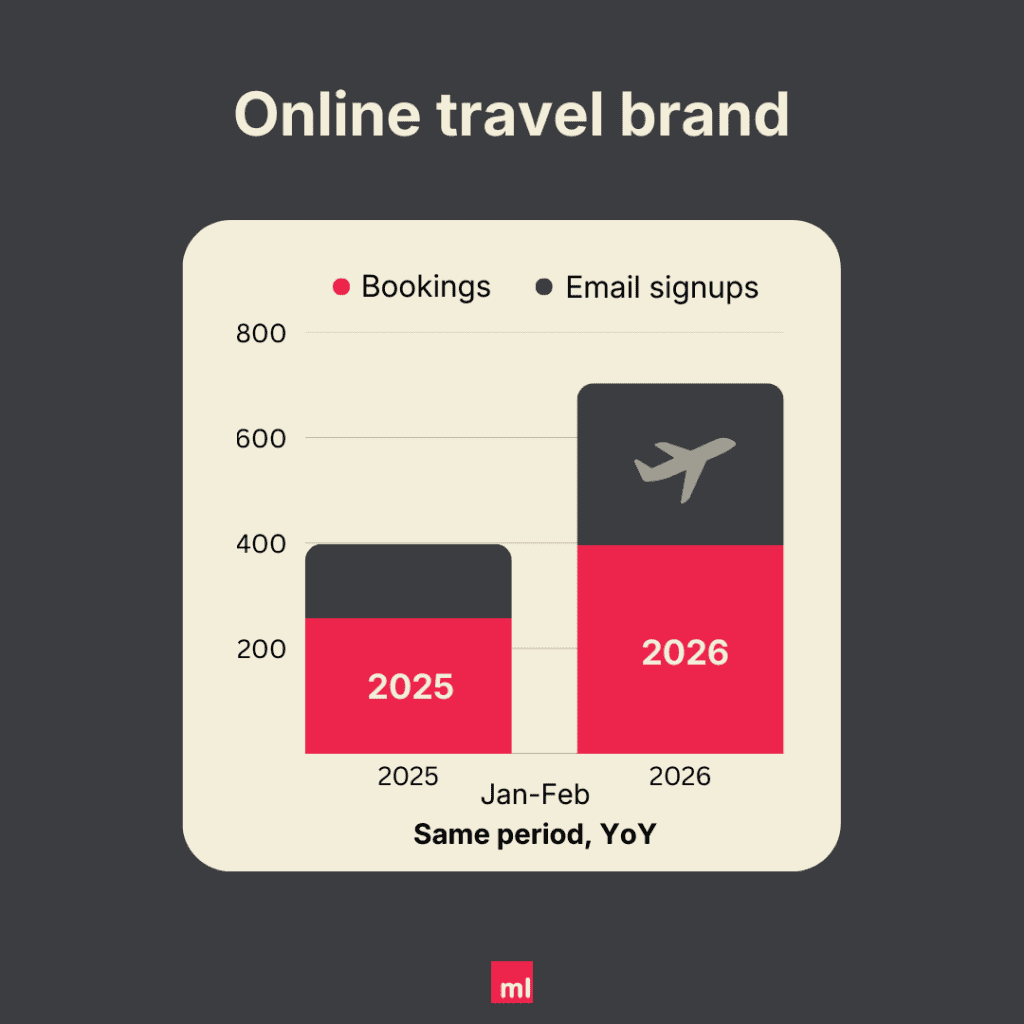
The compound effect is slow, but it’s significant. Brands that commit to Pinterest for twelve months with a proper strategy see meaningfully different results to those that give it three months and conclude it doesn’t work. Here’s a very concrete example of compounding at work for a client in the travel industry:
Travel client: Bookings +54%, e-mail sign-ups +118%
Most e-commerce teams work in short cycles, which suits channels designed for quick feedback loops. Pinterest builds more slowly and more durably. Visibility compounds. Audiences warm over months.
For this client, when comparing January and February year on year, bookings are up 54% and new account signups have more than doubled with a slightly lower budget (7%) than the same period last year. So, essentially with a 7% decrease in spend, Pinterest delivered a 77% increase in total conversions!
When to add Pinterest ads to the mix
The strongest use case for Pinterest ads on a Shopify store is shopping campaigns, particularly catalogue-based ads targeting people in your core categories. These surface your products to users actively searching in relevant areas and can drive strong return on ad spend when the creative and keywords are well matched.
Retargeting is also highly effective on Pinterest, partly because the purchase window is so long. Someone who saved one of your pins three months ago and hasn’t converted yet is still a warm prospect. Pinterest’s retargeting tools let you re-engage them with new creative or a specific offer.
Performance+, Pinterest’s AI-powered ad automation, is worth testing once you have enough conversion data flowing through the tag. It optimises delivery automatically and works well for brands with a clear conversion signal and sufficient catalogue depth. But it’s not a shortcut for brands that haven’t done the foundational work.
Most brands start by testing with a daily budget between £20–£50 to test. Once you know which creative and keywords are working, scaling to £2,000–£3,000 per month gives the algorithm enough data to optimise properly. That’s when paid advertising campaigns start to compound.
How organic and paid should work together
Many Shopify brands separate organic and paid Pinterest activity. They post organic pins inconsistently and run paid campaigns in isolation. The two streams rarely inform each other. That approach limits performance.
Organic Pinterest marketing reveals which keywords generate impressions, which visuals drive saves, and which themes gain traction. Paid campaigns can then amplify what’s already resonating. Conversely, paid campaigns generate data about audience responsiveness, creative angles, and conversion pathways that should inform future organic content.
When organic and paid reinforce each other, Pinterest becomes way more efficient.
The measurement question that always comes up
“If Pinterest is working, why doesn’t the report show it?” A client’s CFO asked this in a recent budget review. Fair question. The CMO knew Pinterest was contributing. Her team could see it in the saves, the returning visitors, the products that kept surfacing in retargeting pools. But the standard report didn’t reflect any of that.
Pinterest users don’t behave like paid social users. They save products. They build collections. They return weeks later, through Google or direct. By the time they convert, Pinterest is nowhere near the last click.
So we adjusted the reporting. Extended the attribution window from 7 to 30 days. Pinterest’s contribution doubled. We added assisted conversions. It practically tripled. The CFO stopped asking.
A more accurate picture comes from looking at assisted conversions in GA4 and running time-lag analysis on your conversion data. When I work with clients on Pinterest measurement, the gap between reported and actual contribution is almost always larger than they expected. Pinterest marketing for Shopify brands is consistently one of the most under-attributed channels in a multi-channel e-commerce mix. Its strength is first and foremost in opening, then closing later. And these are each measured differently.
Most attribution models are built for channels that close. Pinterest is a channel that opens. Different function. Different Measurement.
The exception is shopping catalogue campaigns. These surface your products to people who are already actively searching in your category. They are highly effective in driving direct, attributable conversions. But for the broader Pinterest strategy, the value sits earlier in the journey.
What results should you realistically expect, and when?
Pinterest is not a channel that rewards impatience. Here’s an honest timeline for a Shopify brand starting with a properly structured Pinterest marketing strategy:
Months one and two are about foundations: account architecture, catalogue connected, tag firing, boards structured, keyword optimisation, and consistent organic pinning to prime the account. You’ll see impressions growing but limited traffic or sales. This is normal. The goal is to build the structure that paid campaigns will amplify.
Month three onwards is when paid ads enter the mix. With a primed account and enough organic signal, paid campaigns have something to work with from day one. Two to three months of testing and optimisation, and real return on ad spend becomes visible.
Getting real traction from organic content alone is difficult unless your brand is producing highly pinnable imagery consistently. It happens, but it’s rare. For most brands, the combination of a well-structured organic foundation and targeted paid campaigns is what delivers results.
Is your Pinterest strategy doing what it should?
If you’re not sure whether Pinterest is the right fit for your brand, take the Pinterest Fit Assessment just below. It just takes a couple of minutes to complete and gets you a personalised score to see where you’re at.
Or, if you’d rather just have a conversation about it, I’m happy to help. Book a discovery call and we’ll look at whether Pinterest makes sense for your brand right now. No pitch, just honest input.
Book a discovery call with me here.
How well does your brand fit Pinterest?
Find out where your brand stands.
This free assessment evaluates:
Frequently Asked Questions
Does Pinterest work for Shopify stores?
Yes, but not every Shopify store is a good fit. Pinterest for Shopify stores works best for visually-led brands selling products in categories like home decor, fashion, beauty, food, and lifestyle, where the customer’s buying journey starts with inspiration rather than a specific product search. It performs well across a wide range of price points, though brands with a higher average order value see particularly strong returns.
How long does Pinterest take to drive sales for a Shopify store?
Typically, the first two months are about building foundations: account structure, catalogue, keywords, and organic pinning. From month three, paid campaigns enter the mix and results start to build. With the right strategy, real return on ad spend becomes visible within two to three months of launching paid campaigns. Pinterest content also compounds over time: pins published early on continue accumulating traffic and saves months later.
Are Pinterest ads worth it for e-commerce?
Pinterest ads for Shopify and other e-commerce platforms can deliver strong return on ad spend, but only when the foundations are right: the Pinterest tag is correctly installed, the product catalogue is connected, and there is enough organic content to demonstrate that the creative and keywords resonate. Most brands start by testing with a daily budget of £20–£50 to find what works, then scale to around £2,000–£3,000 per month once the winning creative and keywords are clear.
Why isn’t my Pinterest driving traffic to my Shopify store?
The most common reasons are inconsistent publishing, poor keyword optimisation in pin titles and descriptions, and reliance on white-background product images rather than lifestyle content. Pinterest is a search engine, so pins that don’t include the words people actually search for simply won’t surface. Publishing sporadically also limits reach, as the algorithm favours accounts producing a regular stream of fresh content.
How do I connect my Shopify store to Pinterest?
Install the Pinterest app from the Shopify App Store and add it as a sales channel. This connects your product catalogue to Pinterest, installs the Pinterest tag on your store, and enables product pins that link directly to your Shopify product pages. You’ll also need a Pinterest business account and a claimed website. Once connected, apply for Verified Merchant status to unlock additional distribution and trust signals.
What’s the difference between Pinterest organic and Pinterest ads for Shopify?
The two work best together: organic establishes what content resonates, signals to Pinterest what your account is about, and makes it easier for the platform to surface your content in relevant searches and feeds. Ads then scale what’s already performing and reach specific target audiences that organic alone cannot.
How do I measure whether Pinterest is actually contributing to Shopify sales?
Last-click attribution in GA4 or Shopify analytics consistently underreports Pinterest’s contribution because of its long purchase window. A more accurate approach is to look at assisted conversions in GA4 and run time-lag analysis on your conversion data. Pinterest’s strength is in opening the buying journey rather than closing it, so it rarely gets last-click credit. The exception is shopping catalogue campaigns, where products are shown to people already looking to buy. These are highly effective in driving direct, attributable conversions.
Is Pinterest better than Meta for Shopify?
They serve different roles. Meta excels at demand creation and fast feedback loops. Pinterest captures existing intent earlier in the planning process and builds sustained search visibility. Meta drives immediate scale, while Pinterest builds the discovery layer that feeds new, high-intent traffic into your funnel over time. They work best together as complementary channels rather than competitors.
Any other questions?
If you have more questions about Pinterest marketing for Shopify, I’m happy to help. Drop me a message on LinkedIn or book a discovery call.
You’ll see the value of working with Mary from day one
“Since working with Mary, we have seen tremendous growth in revenue from this channel and continue to hit milestones and reduce cost per acquisition.”

Pin for later!
Mary Lumley – Pinterest Marketing for eCommerce & Travel / Pinterest Marketing for Shopify: What Actually Drives Sales (and What Doesn’t)
