


Pinterest for Business: Why It Works for Some Brands and Not Others
Before putting time or budget into Pinterest for business, it’s worth knowing what it can realistically do for a brand like yours, and whether it belongs in your channel mix at all. Plenty of guides will walk you through the setup, but is it the right channel for your business?
Pinterest works as a visual search engine where people look for ideas and products they intend to buy, then click through to your site. Used well, it drives high-intent traffic that compounds over months rather than spiking and fading. It suits some brands beautifully and others not at all. Your product may be a perfect fit, but your business stage or type matter just as much.
What Pinterest actually is, and why it changes how you use it
Most of the confusion about Pinterest comes from filing it under social media. It looks like a feed, so people treat it like one, posting and hoping for engagement. But Pinterest behaves far more like Google than like Instagram. People arrive with a search in mind, type it into the bar, and browse results made of images, and every pin links back out to a website, which is the whole point of the platform from a business point of view.
On a social feed you’re competing for attention in the moment, whereas on a visual search engine like Pinterest you’re competing to be found when someone goes looking. This puts keywords, clear descriptions and content matched to real search demand at the centre of everything you do on Pinterest. It also means your content keeps working long after you publish it, because the searches keep happening.
Who Pinterest works for, and who it doesn’t
Disappointing results on Pinterest usually aren’t really about Pinterest at all. Whether it works for you comes down to fit. Let’s look at a few examples to show what I mean.
When the website isn’t ready for the traffic
A home decor brand came to me wanting to run Pinterest ads. Strong range, beautiful imagery, exactly the kind of product Pinterest favours. But something about the site felt off, and that was confirmed when they shared a conversion rate well below 1%. Pinterest would have sent them the right people, but the site wasn’t ready to receive them. Adding traffic to a page that doesn’t convert won’t fix the problem, it just makes it more expensive. The first investment there was the website, not the ad budget.
Pinterest works best for a site that already converts. It sends more of the right people, but it amplifies what’s there rather than fixing it, so a page that isn’t converting its current traffic won’t suddenly convert Pinterest’s.
When the volume’s too low
Another example is from a business selling bespoke handmade tables. Lovely product, the sort people save and admire, and they were pinning consistently. But results were disappointing, and the reason was volume rather than effort. Each table was high-ticket and made to order, so they sold very few a month, and with only a handful of products too, Pinterest had too little signal to learn who to show the content to. When I ran the numbers on paid ads, the sales needed to break even didn’t add up either. Some product catalogues are built for Pinterest, and some just need an honest answer about what’s realistic before any budget gets committed.
A small catalogue isn’t a problem in itself. A brand with only a few products can still do well on Pinterest when it sells them in volume, with no supply constraint holding it back. It’s low volume, not a short product list, that limits what Pinterest can do.
When strong assets offset a missing piece
I worked with a paint brand whose product and imagery were a strong fit, and organic performance was good, but they’d built a guided journey on their online store to help customers choose the right product, and that custom setup meant connecting their catalogue to Pinterest shopping needed significant development work. The missing catalogue connection wasn’t a showstopper though, because their other assets were extremely strong. Catalogue-based shopping ads were off the table, but organic still converted and many other types of paid campaigns could still run. Strong enough assets elsewhere meant the missing catalogue connection didn’t hold them back.
When there’s no online shop, but an engaged Pinterest audience
It goes further than e-commerce, too. Some of the brands I work with don’t sell online at all. High-end home decor brands use Pinterest to get in front of architects and interior designers, turning visibility and intent into inbound enquiries, with no shop involved, just qualified leads. Interior designers are among the platform’s most engaged professional users, regularly building boards to research products and plan client projects, so if they’re the people you want specifying your brand, it makes sense to be where they’re already looking.
The conditions that make Pinterest work
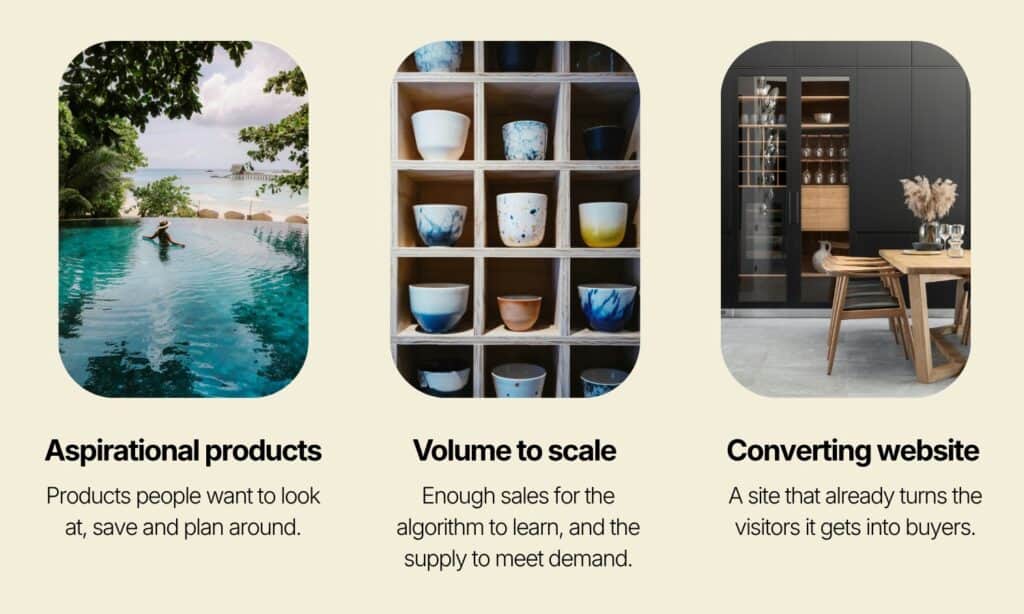
It comes down to three things. Pinterest suits aspirational products, the kind people enjoy planning around, and it needs enough sales volume behind them for the algorithm to learn from and for paid campaigns to perform. The third is a website that already converts, because Pinterest sends more of the right people but it can’t make a site sell if it isn’t already converting.
Connecting your product catalogue to Pinterest is well worth doing, since it unlocks shoppable pins and catalogue ads, and for most brands it’s straightforward to set up. On the rare occasion it isn’t, strong performance elsewhere on Pinterest can offset it, as the paint brand earlier showed. You lose the shoppable product features that depend on the feed, but everything that links a pin to your site, organic and paid alike, still works.
When the core three line up, Pinterest compounds, so saved pins keep building intent in the background while return visits gradually turn into purchases and paid campaigns become more and more effective as the data accumulates. When they don’t, results disappoint and the platform gets blamed for what is really a fit problem.
That’s why the first conversation I have with any brand is about fit, not tactics. Sometimes Pinterest makes sense, sometimes it will but not yet, and sometimes it doesn’t. I’d rather tell a brand that early than take on work that won’t deliver.
What Pinterest does for your business
Assuming you and Pinterest are a good match, here’s what Pinterest actually contributes.
Traffic with real intent behind it
What makes this traffic valuable is the intent behind it. People come to Pinterest to plan and to shop rather than to scroll, so there’s real purpose behind every visit, though they arrive at different stages, some early and gathering ideas for a project that’s months off, others close to buying and ready to click. So you can meet the early planners with inspiration and content whilst steering the ready-to-buy visitors to your product pages. You can point that traffic wherever you need growth, whether that’s your shop, blog content, or a lead magnet to build your email list.
Content that keeps working for months
What separates Pinterest from social platforms is how long content keeps working, and the reason comes down to saves. When someone saves a pin, Pinterest reads that as a sign the content is worth showing to more people, so it surfaces the pin more widely, those new viewers save it in turn, and that loop keeps a good pin circulating long after you publish it.
This is why Pinterest content compounds. Multiple marketing analyses put the half-life of a pin at roughly three and a half to four months, and Pinterest’s own referenced research suggests its content lasts far longer than content on other platforms. So in practice a pin can keep driving traffic for months, sometimes years, while a typical Instagram post’s reach peaks within a day or two. The effort compounds rather than evaporating overnight, which is what makes Pinterest for marketing reward patience in a way paid social rarely does.
A head start on demand
Pinterest also gives you unusual forward visibility. The Pinterest Trends tool shows what people are searching for and when interest peaks across the year, so you can publish ahead of demand rather than chasing it. For seasonal businesses and travel brands especially, that head start makes all the difference.
Shoppable pins and product ads
And if you sell products, connecting your catalogue for e-commerce turns pins into shoppable product pins that carry price and availability, and opens up shopping ads that can retarget people who’ve already viewed your items. Rich pins pull live product detail straight from your site, and Pinterest analytics shows you how these pins are performing.
Pinterest is also working hard to shorten the path from discovery to purchase. Recent additions include Amazon Storefront linking for creators, a pre-built Performance+ shopping campaign you can launch straight from the Pinterest Shopify app, and inclusion in Shopify’s pay-on-conversion Shop Campaigns. More of the buying journey is moving in-app, which means a little more of Pinterest’s contribution is becoming directly trackable, though the wider influence still sits earlier than the last click.
Pinterest for business: where to start
Start by setting up a Pinterest business account, which is free and gives you analytics and ads, your website claimed so your name and picture sit on every pin from your site, and pins built around real search terms rather than clever captions.
The keywords are the part to focus on. Because Pinterest is searched by people, your titles and descriptions need the words your customers actually type, which makes Pinterest SEO the difference between content that surfaces and content that nobody sees. Pair good keywords with strong vertical images and a clear call to action on the pin, and you’ve got the basics that carry most brands a long way. Beyond that, a proper Pinterest marketing strategy ties your pinning to search demand and your wider goals, but those foundations are what everything else builds on.
How long before Pinterest works, and why it compounds
It depends on whether you’re running ads or building organically, because the two work on different timelines. Paid campaigns bring traffic almost as soon as they go live, but conversions take longer to follow, for two reasons. First, the algorithm needs a testing period to learn which audiences respond best before it starts to deliver efficiently. Second, there’s a natural gap between someone seeing your product and deciding to buy, and how long that takes depends on where they are in their journey and on the product itself, since a higher price means a longer decision.
Organic is slower again by nature, building over months rather than days, but it’s the essential ingredient that gives paid its edge. As your account matures it warms your audience and feeds the algorithm, so your ads reach people already familiar with you, and content from six months ago can start performing again. Most brands see organic traffic build within a few months, with the stronger results arriving once everything starts to build on itself.
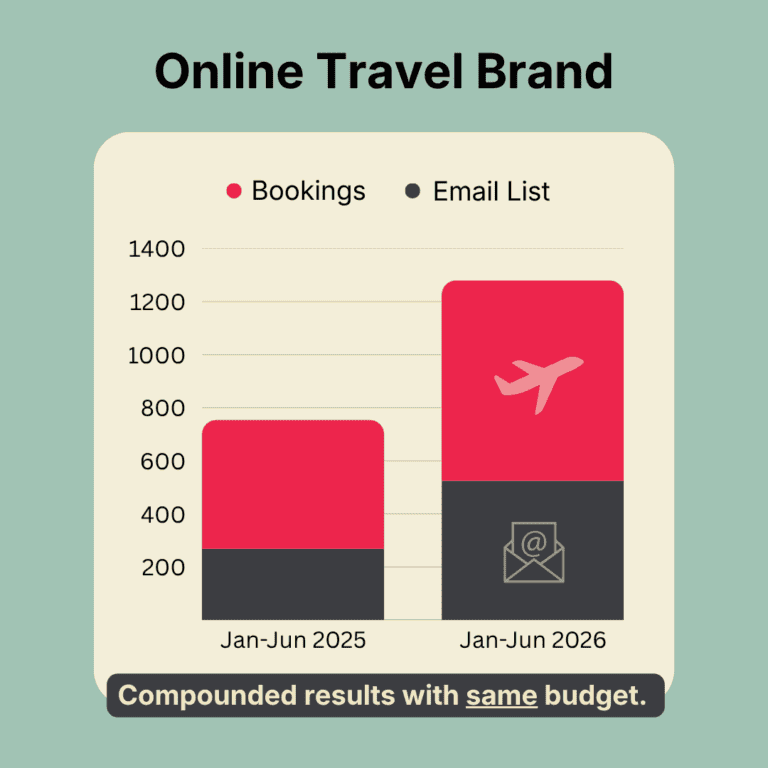
A travel client of mine illustrates what that looks like over a longer horizon. Comparing the same January to June window year on year, their bookings are up 56% and new account signups have doubled, while ad spend is actually slightly lower than the year before, which brought cost per booking down by almost 40%. There is no last-minute lever behind that. The consistent, keyword-led pinning and board structure are already in place, along with seasonal content planned months ahead, well before the season arrives. That’s Pinterest compounding, and it’s why the wait pays off.
A note on measuring it properly
One reason Pinterest gets misjudged is measurement. Pinterest users don’t behave like paid social users. They save products, build collections and come back weeks later through Google or by typing your name in directly, so by the time they buy, Pinterest is rarely the last click, and a standard 7-day attribution window misses most of that.
It’s a very common scenario. The CFO looks at the numbers, can’t see Pinterest contributing, and questions the spend, while the marketing team knows it’s doing real work, and the gap between those two views is the reporting rather than the channel. Widen the window to 30 days (or 60 days depending on the type of product) and bring assisted conversions into view, and Pinterest’s measured contribution often roughly doubles, sometimes close to tripling once assists are fully counted. Nothing has changed on the platform, but aligning the reporting with how people use it brings Pinterest’s real contribution into view.
So if you’re evaluating Pinterest, set the measurement up for how the channel works before you judge it. A short click window built for channels that close quickly will always undersell a channel that opens the journey and lets others close it.
Is Pinterest right for your brand?
Pinterest rewards the brands it genuinely suits, so the first step is working out whether yours is one of them. When there’s a clear match, and you build consistently around real search terms and measure Pinterest for how people actually buy rather than on a short last-click window, it gives you something most channels can’t: high-intent traffic that compounds over time instead of fading in a day.
A clearer view on Pinterest, in 20 minutes
If you’d like to know what Pinterest could realistically do for your brand, book a discovery call. Bring your questions, your goals, or just your curiosity. No pitch, just a straight conversation about whether Pinterest is worth your time and where to focus if it is.
Frequently Asked Questions
Is Pinterest good for business?
Pinterest works well for businesses with aspirational products, enough volume for its algorithm to learn from, and a website that already converts. It drives high-intent traffic that compounds over months, which suits e-commerce and travel brands particularly. It’s a poor fit for very narrow, high-ticket catalogues with little sales volume, or for sites that don’t yet convert the traffic they already get.
How do I use Pinterest for my business?
Set up a free Pinterest business account, claim your website so your brand appears on every pin from your site, and create pins built around the keywords your customers actually search. Treat Pinterest as a visual search engine rather than a social feed, so titles, descriptions and clear imagery do more for you than sheer posting frequency. Link every pin to a relevant page that delivers what the pin promises.
What types of business work best on Pinterest?
Brands with lifestyle products and genuine search demand do best: home decor, fashion, food, beauty, travel and design-led e-commerce. Service and B2B brands can work too when the offer is visual or the goal is lead generation, such as interior brands reaching architects and designers. The common thread is a website that converts and either a catalogue that connects to Pinterest shopping or a strategy that performs well organically.
How long does it take to see results from Pinterest?
Most brands see meaningful traffic within a few months, with stronger results arriving once the account has matured and the algorithm understands it. Pinterest compounds rather than spiking, so the bigger gains show up over six to twelve months of consistent activity. One travel client’s groundwork over a year produced a 56% rise in bookings in the first half of the year on lower ad spend.
Is a Pinterest business account free?
Yes. A Pinterest business account is free to set up and gives you analytics, audience insights and access to ads. You only pay if you choose to run paid campaigns, and you set your own budget for those.
How is Pinterest different from Instagram for business?
Instagram is a social feed where reach peaks within a day or two of posting, while Pinterest is a search engine where content keeps surfacing for months as people search. A pin’s half-life is estimated at around three and a half to four months, far longer than a social post, so Pinterest favours evergreen, search-led content over timely updates. It’s also built to send people off-platform to your website, which makes it stronger for driving traffic and sales.
Why doesn’t Pinterest show up properly in my analytics?
Pinterest users save and return weeks later through search or direct, so a standard 7-day attribution window credits the final channel and misses Pinterest’s earlier influence. Widening the window to 30 days and including assisted conversions reveals a much larger contribution. Pinterest opens the buying journey, so measuring only the last click will understate it.
Any other questions?
If you have more questions about how to use Pinterest for business, or you’d like a straight read on whether it fits yours, I’m happy to help. Drop me a message on LinkedIn or book a discovery call.
Pin for later!
Mary Lumley – Pinterest Marketing for eCommerce & Travel / Pinterest for Business: Why It Works for Some Brands and Not Others
